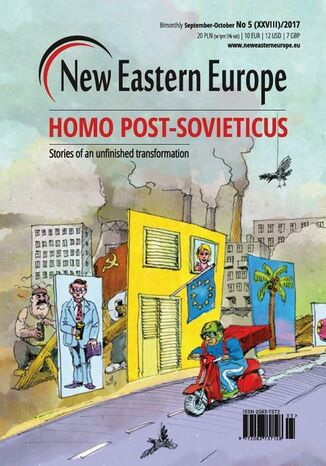
Dear Reader, It has become quite fashionable, and arguably correct, to dispute Francis Fukuyama's theory that the collapse of the Soviet Union brought about the end of history. Anyone interested in Central and Eastern Europe understands that this region is far from monolithic, also in the implementation (or lack thereof) of western economic and political systems.
At the same time we cannot deny that there is something idiosyncratic about the former Soviet bloc, something which links its societies together. It allows our authors to talk about the legacy of the socialist past which, as they argue, has not yet fully disappeared.
These traces have been captured by a group of photographers who collectively call themselves the Sputnik group (not to be confused with the pro-Kremlin Sputnik media). Their unique project is presented by Wojciech Górecki in the opening essay to this issue and is accompanied by some of their illustrative photographs.
In addition, we tackle the issue of the incomplete system transformation which, in many cases, has allowed for a creation of hybrid socio-economic systems. They may, like in Georgia as discussed by Kaja Puto, be a result of a hasty reconstruction of the state to look more like what is believed to be the West.
Or, as is the case of Belarus, which is analysed by Maxim Rust, reveal a slower emergence of collective identity that is both submissive and open, passive and entrepreneurial. In the case of post-Maidan Ukraine, where without a doubt the transformation has gone much further, the rooting of the western value system is also still under way.
Additionally, in this issue we have prepared two special sections: the first one, published on the 500-year anniversary of Martin Luther's Ninety-five Theses, debates the legacy of the Reformation from our region's standpoint, while the second, at the end of the issue, is dedicated to Joseph Conrad - a Polish-born writer whose masterpieces have been read and studied throughout the world for generations. It will provide new features to subscribers, who will not only be able to access our digital archive, but also read each text from the issue online via their web browser.