Articles Marcin Przychodniak A New Strategy or Just a Change of Tactics? The Main Elements of China's Foreign Policy during Xi Jinping's First Term (s.
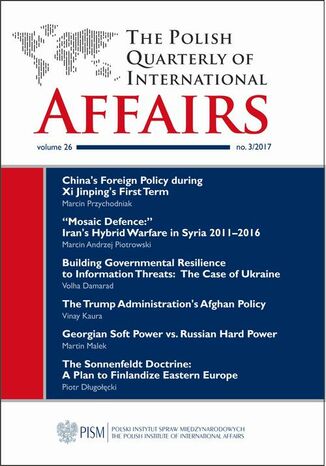
5) Modifications of China's foreign policy during Xi Jinping's first term as China's Communist Party (CCP) secretary general are predominantly due to a change in strategy rather than in China's core interests (its main goals). The new strategy focuses on fulfilling Chinese strategic interests rather than on providing economic benefits to guarantee development.
Xi's re-election to a second term during the 19th Party Congress means China's activity on the international arena will be enhanced. 18) Iran has developed an indigenous concept of hybrid warfare known as "mosaic defence" and used for saving the allied regime in Syria.
Despite Tehran's unique regime and ideology, during the Syrian civil war Iran also demonstrated a broad spectrum of instruments for hybrid warfare: military, paramilitary, socio-cultural and religious, as well as information and cyberwarfare. An in-depth analysis of the most recent cases of information threats assesses the level of governmental resilience and points to possible developments in the field.
While the ultimate policy objective remains political reconciliation in Afghanistan, the Trump administration believes that only a strong Afghan government, coupled with gains on the battlefield, will force the Taliban to consider a peace settlement. The article argues that Trump's Afghan policy is likely to enhance India's role and contribution to Afghanistan's reconstruction and development, making India a crucial element of America's new South Asia strategy.
109) The text takes a closer look at the problem of South Ossetia's "creeping border" and its international implications. The meeting dedicated to American foreign policy in Europe was secret, but information leaked to the press gave rise to the notion of the "Sonnenfeldt Doctrine," triggering an international debate on U.S.
Media speculation about the "doctrine" put the authorities in Warsaw in an awkward position, resulting in denials that the State Department considered Eastern Europe a Soviet sphere of influence. REVIEW Justyna Zając: Poland's Security Policy: The West, Russia, and the Changing International Order (Bartosz Wiśniewski) (s.